
Sometimes on point and sometimes not so much
I haven’t met a single person of aboriginal descent over the few weeks I’ve been in Sydney, however, the faces I’ve yet to meet have held my interest more than any other people in Australia. I’m consistently met with conversation or political artistic dissent surrounding them in the streets or museums, but never face-to-face. I’ve seen the well-intentioned irrelevant attempts to reconcile the past that turn aboriginal people into tokens rather than giving them equal status. On the other hand, I’ve seen strides made, and it’s important to know the difference. My time in Sydney has shown me both.
Our first trip as a group took us to the Blue Mountains — a two-hour drive west out of the city center in Darling Harbor. The town at the base of the mountain reminds me of Big Bear in Southern California. A quaint, sleepy town with small family-owned businesses used to tolerating tourists.
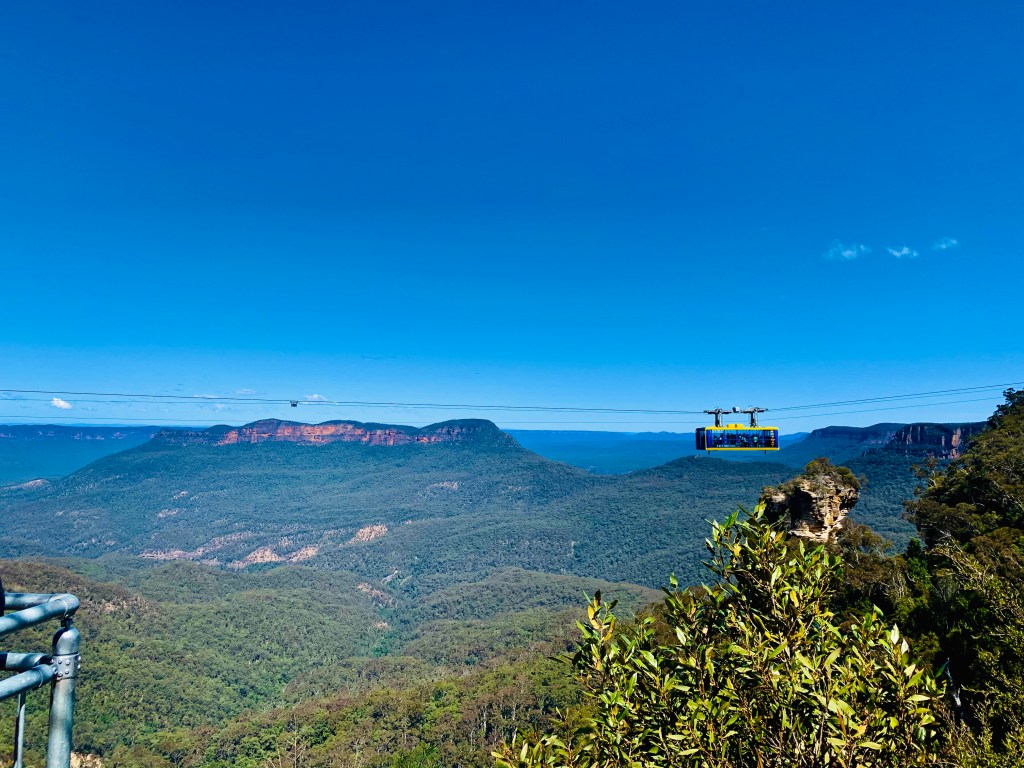
The landscape is dense with ferns on the ground, white cockatoos with their flamboyant yellow crests, and gum (eucalyptus) trees for mile after mile — the perfect setting for a new generation of Jurassic Park movies. I felt if I wasn’t constantly on-guard a pterodactyl would swoop me away. My impression of Australian wildlife being hostile still stands.
The tour guide was a salt-and-pepper sailor-type that liked to make crude jokes. We got along great. One of the first things he pointed out were the tiny burrows in the dirt along the trail. They belonged to one of the world’s deadliest spiders. He gave little hope of survival by mentioning the spider’s fangs could pierce through a steel toe shoe. To my luck, I decided to wear my strappy Chacos.
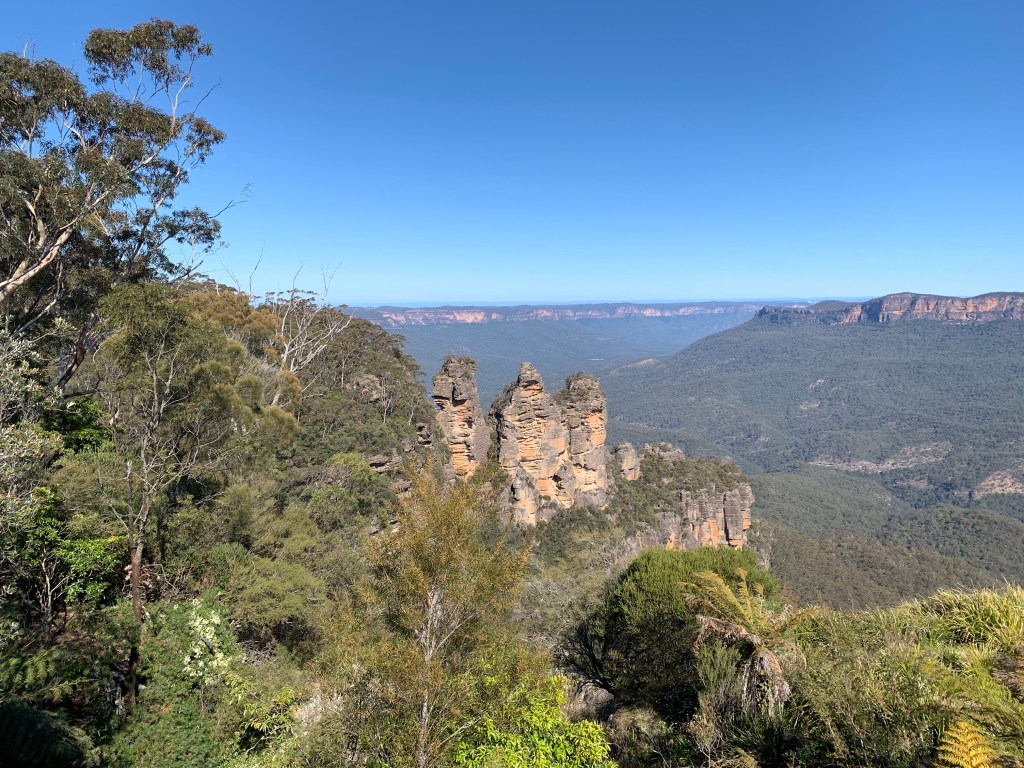
All 53 of us walked up the mountain until we came to a vista with three naturally occurring stone pillars in the distance. He told us the local aboriginal story behind their presence. He said a father escaping a giant serpent turned his three daughters into stone so they wouldn’t be eaten. He promised to return to change them back into humans, but he never could. They’ve stood there ever since.
The tour guide quickly commented after the story by saying we could either believe the story or that millions of years weather shaped the mountain range. In retrospect, I don’t understand why both can’t be true. That comment gave a false choice that insisted we use “logic” to make the best decision. However, our logic is often grounded in what we know from the scientific method. To the aboriginal people of the Blue Mountains, a man using magic to turn his children into stone for their protection is logic.
We moved on from the three pillars to the next stop where our tour guide showed us traditional aboriginal face paints made from putting water on different frail stones. I’m sure this kind of practice occurs on special occasions, but it suggests that aboriginals can only exist in a romanticized form as someone being one with nature and wearing face paint — and not as any other person living in 2019.
This reminds me of the recent Dior Sauvage fragrance campaign controversy. The premise of the fragrance commercial is that Johnny Depp leaves the city and his possessions to live as, well, a savauge. Adding a letter to a word that’s problematic in this context and making it French doesn’t make it okay — or art. Yet, it’s a perfect example of romanticizing indigenous people. There are indigenous people that do live off the land in a pastoral lifestyle, such as some of the tribes in the Amazon, but there is an overwhelming lack of variety in how indigenous people are portrayed in media. They are constantly used as a snapshot of the way things used to be without regard to the fact they’re cultures and practices have evolved with time and a changing world.
Our second group tour brought us to the Art Gallery of New South Wales where we saw everything from colonial period art to contemporary interactive video galleries. Loraine, our teacher on these excursions for the quarter, took us downstairs to the Aboriginal gallery. She explained that many of the pieces there were new additions to the museums because of a new movement calling for Aboriginal things to be viewed as art and not an artifact — which would be shown in a natural history museum. There were intricate designs on pieces of driftwood and canvases that covered an entire wall with colorful patterns. I wondered why anyone debated their legitimacy as art in the first place, however, I think it’s a move in the right direction. It truly places people of indigenous descent on the same level as true artists in the sense of the western world.
On my way home from Rose Bay recently, I noticed the Museum of Contemporary Art out of the corner of my eye from the ferry as it was pulling up to Circular Quay. It started to rain, so I decided to wait it out inside the museum. I discovered a gallery by well-known Aboriginal artists named Destiny Deacon. She had a whole gallery to herself to talk about her experience trying to navigate duel lives. One at home with her Aboriginal family, and the other with the people of Melbourne.
I think the strides made in Australian culture to appreciate and include Aboriginal people have come a long way, but with much left to address, and the same can be said about the United States. We must understand that appreciating a group of people is not like staring at them through a glass window in a natural history museum but is passing them on the street and seeing them at work.
Cheers!
 Just Josh Abroad